
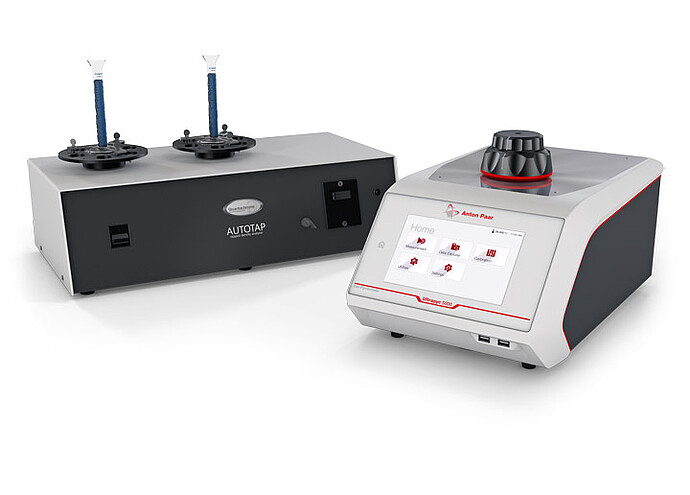
Semi-Solid and Solid Density Meters
A Complete Solution for the Density Measurement of Powders, Solids, and Semi-Solids
Our solid density analyzers are tried-and-tested solutions. The Autotap and Dual Autotap tapped density analyzers conform to a wide range of international standards for the determination of bulk density. The Ultrapyc automatic gas pycnometers are ultra-simple to use and provide ultra-precise skeletal density or true density measurements of your solid and semi-solid materials. The Brabender ElaTest uses an integrated balance and volume displacement measuring system to determine the density of rubber compounds even in harsh production environments.
Anton Paar Products
Easy to use
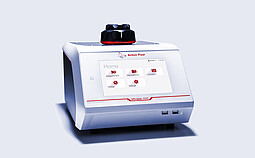
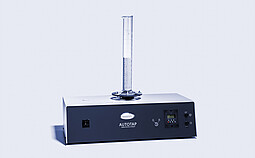
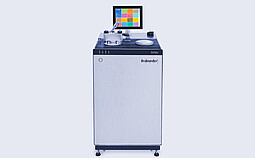
The Autotap, Ultrapyc, and Brabender ElaTest instruments make it easy to determine the solid density of your materials. Tapped density analysis with Autotap is straightforward. The Ultrapyc’s intuitive user interface, presented on a large, bright touchscreen, lets you navigate quickly and adjust settings as well as begin, pause, and stop measurements. Since you don’t need a computer for operation, the Ultrapyc even saves bench space. The Brabender ElaTest can be easily controlled via the browser-based MetaBridge software.
Accurate and precise
All Autotap instruments come with Class A graduated cylinders, which are fundamental for obtaining high-accuracy tapped density results. These instruments also deliver consistent results from the specific drop height as well as precise tapping frequency to which they are set during manufacture. The TruPyc technology used on Ultrapyc gas pycnometers ensures accurate true density results in any of their supplied sample cells over the widest available sample range. The TruLock lid closure system on the Ultrapyc provides 0.02 % precision and 0.01 % repeatability. The Brabender ElaTest is the perfect choice to measure the density of uncrosslinked rubber compounds.
Conforms to many internationally recognized test methods
The current instrument designs ensure conformity with a host of ASTM, ISO, UOP, USP, MPIF, and JIS test methods that specify the use of specific technologies.
A broad range of applications
Our density analyzers are designed for a wide variety of samples, including food, personal care products, paint, asphalt, rubber, and adhesives. For the Ultrapyc series, use any of the provided sample cells, and the intelligently engineered instrument automatically selects the appropriate reference chamber. PowderProtect mode eliminates instrument contamination with fine powders or slurry vapors. The built-in Peltier temperature control with a range of 15 °C to 50 °C means there’s no need for external water baths.
Single-station and dual-station options
Our tapped density instruments are available with either one or two analysis stations: Add the second and double your throughput.
Webinars

We offer you a great and constantly growing choice of live webinars and recordings on products, applications, and scientific topics.
View webinars